Google Kills ChromeOS, Introduces Googlebook with Gemini Cursor AI
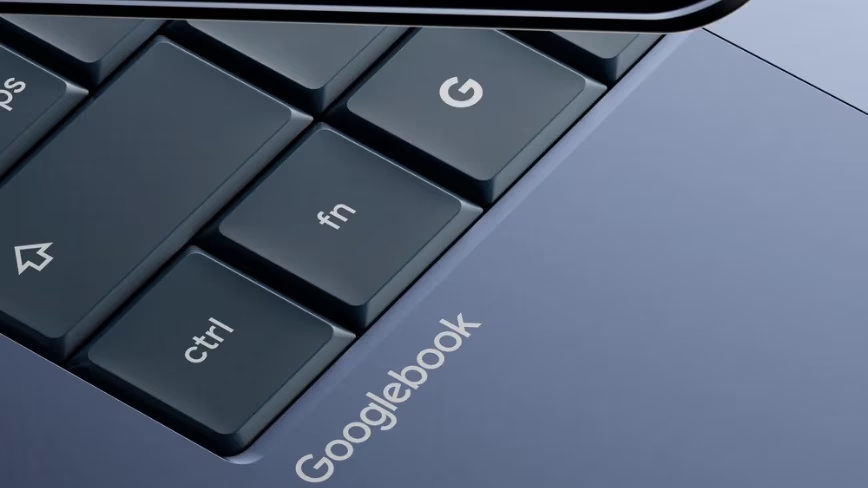
Google announced the end of ChromeOS at the Android Show on Monday, replacing it with Googlebook — a premium laptop running Aluminium OS, a desktop-optimized version of Android 17. The devices ship this autumn from Acer, ASUS, Dell, HP, and Lenovo. ChromeOS will no longer receive updates.
Aluminium OS: Native Android on Desktop
Aluminium OS is not a container or emulation layer. It's Android rebuilt as a genuine desktop platform with a custom window manager and native multitasking. Android apps run natively, accessing the file system and hardware directly — a problem that plagued Chromebooks for years.
Magic Pointer: The Cursor as AI Agent
Built with DeepMind, Magic Pointer transforms the cursor into a context-aware AI agent. Wiggle over a date in an email — Gemini offers to schedule a meeting. Point at two images — it composites them. Select a paragraph — it summarizes, translates, or rewrites. No prompts required: the cursor reads context and surfaces actions automatically.
This differs from Apple's per-app AI and Microsoft's Copilot sidebar. Google embeds Gemini into the pointing device itself, making AI the interface rather than an assistant.
Create Your Widget: Vibe-Coded Dashboards
Users describe a custom widget in plain language (e.g., "show my upcoming meetings and today's weather"). Gemini builds it on the spot, pulling data from Gmail, Calendar, web searches, and other Google services. No coding, no selection from a catalogue — describe what should exist, and the machine builds it.
Unification of Android Ecosystem
Googlebook solves the ChromeOS-Android split. Android apps run natively. Cast my Apps lets users open any phone app on the Googlebook screen without downloading it. Quick Access provides direct file access from the phone via the laptop's file browser. The phone and laptop share an OS, app ecosystem, and AI layer.
Regulatory Collision
The European Commission is preparing to force Google to give rival AI assistants the same OS-level access as Gemini. The DMA decision is expected in July; Googlebook ships in autumn. The outcome could determine whether Gemini integration becomes a competitive moat or a mandated open platform.
Market Positioning: Premium Only
Googlebook is positioned as a premium product with "premium craftsmanship" and a Glowbar — an LED strip that animates with Gemini activity. No low-end models. This abandons the education market where Chromebooks hold >60% share, serving 38 million K-12 students. Existing Chromebooks get security updates until their auto-update expiration; some may qualify for opt-in upgrade to the new platform, but pricing is unannounced and expected higher.
Technical Details
- Aluminium OS is based on Android 17 with a custom window manager.
- Magic Pointer uses DeepMind models for context-aware action prediction.
- Widgets are generated via vibe-coding — natural language description to live widget.
- Snapdragon X Elite chips provide AI inference; Intel previews next-gen AI PC processors at Computex 2026.
- Gemini integration is cloud-first initially, with on-device AI expected via ARM partnerships.
Why It Matters for Developers
Googlebook represents a paradigm shift: AI is no longer a sidebar or assistant but the core interaction model. Developers building for Android must now consider that their apps will run on laptops with cursor-level AI context. The widget system means users can generate UI without code — potentially reducing demand for traditional widget development but opening opportunities for AI orchestration layers.
Editor's Take
I've been using Chromebooks for years, and the Android app container experience was always frustrating — apps felt bolted on. Googlebook's native Android approach is technically sound, but I worry about the education gap. Chromebooks succeeded because schools could buy them in bulk for $200. If Googlebook starts at $800+, school districts will stick with existing Chromebooks or switch to cheaper Windows laptops. Also, the DMA ruling could force Google to open up Gemini access, which might actually benefit developers by creating a more level playing field for AI integrations.
Developer Insights
- Start exploring Android 17's desktop features and window manager APIs now.
- Consider how your app's UI adapts to cursor-based interaction and Magic Pointer context.
- Monitor DMA decision in July — it may mandate open AI assistant access, changing how you integrate AI.
Tags
Googlebook, Android 17, Gemini, ChromeOS, AI cursor, Magic Pointer, Aluminium OS, DeepMind