Huawei's Chip Lab Goes Public
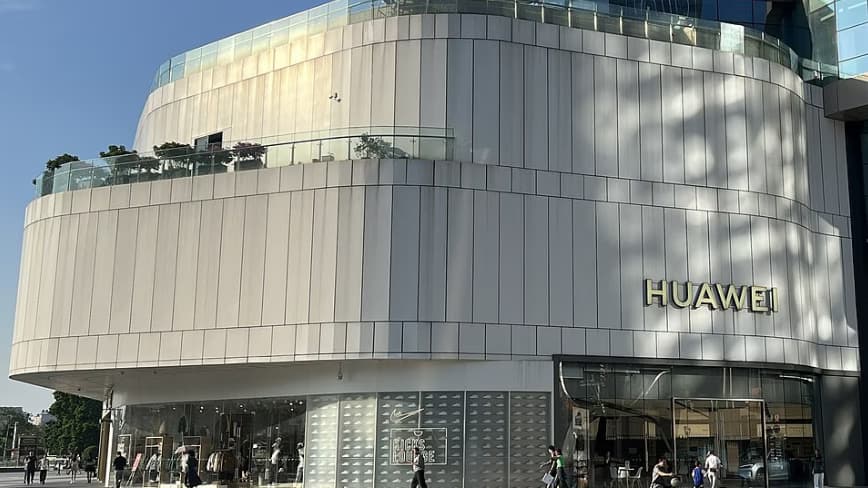
On Friday evening, China Central Television's flagship news program Xinwen Lianbo aired footage of Huawei's Chip Fundamental Technology Research Laboratory at the Lianqiu Lake campus in Shanghai. The segment showed Huawei founder Ren Zhengfei hosting Vice-Premier Ding Xuexiang, who oversees China's science and technology policy. The broadcast did not disclose what the lab is developing. It didn't need to. The timing—48 hours before President Trump's state visit—was the message.
The Campus: Bigger Than Apple Park and Microsoft Redmond Combined
Lianqiu Lake is Huawei's largest R&D center globally. It covers 2,600 acres in Shanghai's Qingpu district, cost 10 billion yuan (~$1.4 billion), and took three years to build. The facility has eight blocks, 104 buildings, over 40,000 offices, and an internal railway system. It will house 35,000 researchers working on semiconductors, wireless networks, smartphones, autonomous vehicles, and energy systems. The chip lab itself had never been shown on state media before.
The Chips: Ascend Series Performance
Huawei has been on the US trade blacklist since 2019, barred from buying advanced chips or manufacturing equipment. Yet its AI chip revenue is projected to reach $12 billion in 2026, a 60% increase from 2025. The company targets 1.6 million Ascend dies this year.
- Ascend 910C: Fabricated by SMIC on a 7nm process without EUV lithography. It delivers ~60% of the inference performance of Nvidia's H100.
- Ascend 920: Built on SMIC's 6nm node, produces 900 teraflops and 4 TB/s memory bandwidth.
- Ascend 950PR: Entered mass production in March 2026. Huawei has orders for nearly 800,000 units this year, on top of similar volume of older chips.
DeepSeek released its V4 models in late April, with day-zero adaptation for Huawei's Ascend chips. DeepSeek rewrote core code to use Huawei's CANN framework, moving away from Nvidia's CUDA ecosystem. The chip lab is not doing theoretical research—it's producing silicon that runs China's most advanced AI models.
Investment and R&D Intensity
Huawei spent 96.9 billion yuan on R&D in H1 2025—22.7% of revenue, a record proportion that caused net profit to fall 32%. Through its investment platform Hubble (established in 2019), Huawei has invested in over 60 Chinese semiconductor firms. Ren Zhengfei claims a network of 2,000+ Chinese companies working toward 70% semiconductor self-sufficiency across the value chain by 2028.
SMIC's 7nm node for the Ascend 910C was achieved by repurposing older DUV lithography equipment in unintended ways. Yield rates are lower than TSMC's, costs higher, and chips less powerful than Nvidia's latest. But that's not the point.
The Geopolitical Message
The broadcast is a negotiating tactic. China's semiconductor industry remains behind the leading edge—the performance gap between Huawei's best chip and Nvidia's best is measured in generations. But the strategic question for Trump's delegation is whether export controls designed to prevent China from trying have instead consolidated an entire national semiconductor ecosystem under one company the US cannot reach.
Nvidia's Jensen Huang called DeepSeek running on Huawei chips a "horrible outcome" for America. That outcome is now reality: China's most powerful open-source AI model runs on Huawei hardware.
China's integrated circuit exports rose 83.7% year-on-year in April. The country earns ~$500 million per hour from exports, with AI-related hardware accounting for half the growth. The dependency export controls were designed to exploit is being replaced by the infrastructure the controls provoked.
What This Means for Developers
For developers building AI applications, the ecosystem shift from CUDA to CANN is real. If you're targeting the Chinese market or deploying on domestic hardware, you'll need to port your models. DeepSeek's rewrite shows it's possible but non-trivial. Expect more Chinese AI models to follow suit, and expect Huawei's Ascend ecosystem to grow in capability and market share.
Next Steps
Monitor Huawei's Ascend roadmap—the 920 and 950PR are already in production. If you're a developer working with Chinese AI companies, start familiarizing yourself with the CANN framework. The US-China semiconductor decoupling is accelerating, and the software stack you choose today may determine which hardware you can run on tomorrow.