The Real Story of Hermes Agent: Compounding Capability and Its Hidden Bills
Most write-ups about Hermes Agent tell you the same true thing: it's a self-improving, self-hosted agent that learns across sessions and gets better the longer it runs. That's accurate. It's also the easy half of the story.
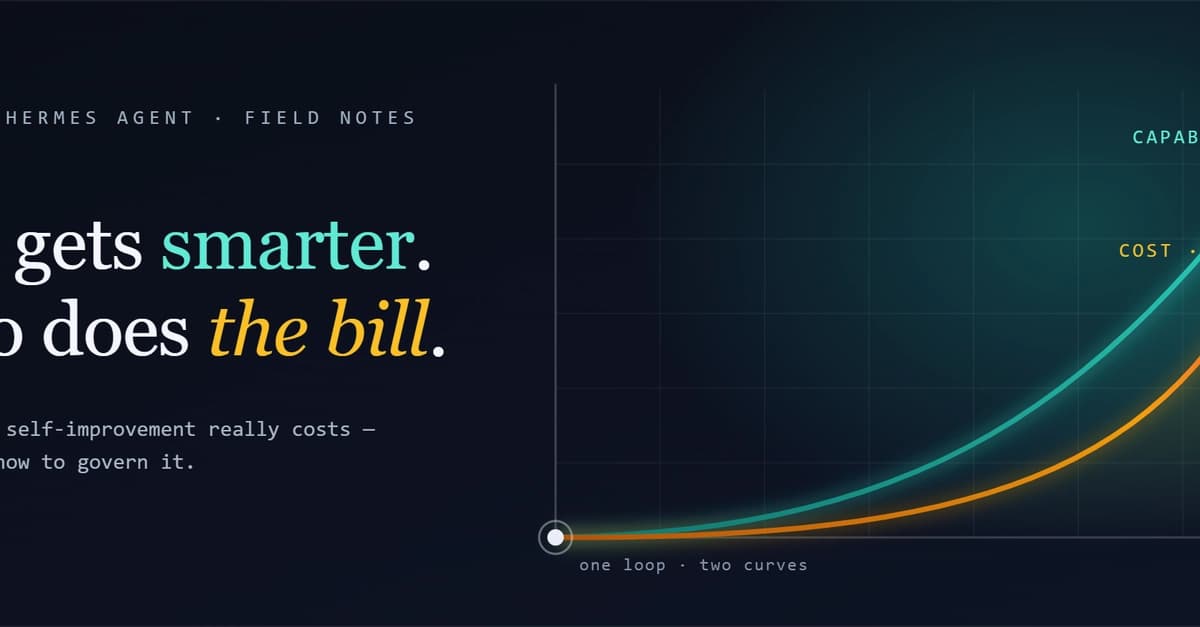
The half almost nobody writes is this: a system that compounds capability compounds everything else too — cost, drift, and the size of the trust you've extended it. Self-improvement is not a free upgrade that arrives while you sleep. It's a loan. The agent draws down capability now and bills you later in tokens you didn't predict, skills you didn't review, and code running on your server that you didn't write.
This article gives that second half an honest, engineering treatment — the kind you'd want before putting an autonomous agent on a box you own. If you're new to agents, the first two sections bring you up to speed in plain language. If you've already deployed a few, skip to "The liability side," which is where the interesting, under-discussed problems live.
The thesis in one line: Hermes is the most honest implementation of compounding autonomy I've seen — and compounding is exactly the property you have to manage, not just enjoy.
What Makes Hermes Different
A normal LLM call is stateless. You ask, it answers, the slate wipes. Tomorrow it has forgotten not just your name but the entire solution it worked out for you an hour ago. Every session pays full price to rediscover what it already knew.
Hermes is built around the opposite assumption. It runs as a long-lived process on infrastructure you control — a VPS, a Docker container, an SSH host, a serverless backend. Because it's a process and not a request, it can keep things between sessions. Specifically, three things:
- Memory — a searchable record of past sessions (Hermes uses SQLite full-text search plus LLM summarization to keep it from bloating), so it can recall what happened last Tuesday.
- Skills — and this is the part that changes the game. When Hermes works out how to do something, it can write that procedure down as a plain markdown file in its skills directory, then load and reuse it later. Skills are not a vector database and not fine-tuning. They are readable, version-controllable files: instructions the agent wrote for its future self.
- A loop — the agent is nudged to curate that memory and refine those skills while it works, not in some offline training run.
That's the whole magic, demystified:
┌─────────────────────────────────────────────┐
│                                             │
▼                                             │
┌─────────┐    do the task    ┌──────────────┐     │
│  task   │ ───────────────▶  │  reasoning   │     │
└─────────┘                   └──────┬───────┘     │
                                      │             │
                    "this worked, keep it"    │
                                      ▼             │
                    ┌───────────────────┐   │
                    │  write / refine   │   │
                    │  a SKILL (.md)    │───┘
                    └───────────────────┘
next time the task appears, load the skill
instead of re-deriving the solution
The skill file itself is unglamorous on purpose. Conceptually:
---
name: weekly-revenue-brief
description: Assemble the Monday revenue summary for the team
---
1. Pull last 7 days of orders from the data source.
2. Compare against the prior 7 days; flag any metric moving >15%.
3. Summarize in 5 bullets, lead with the biggest mover.
4. Deliver to the #leadership channel before 9am.
The first time, the agent reasons its way to that procedure from scratch — expensive, slow, uncertain. Every time after, it loads four lines of markdown and executes. That is the compounding asset. Re-derivation cost drops toward zero. Hold onto that sentence; it's the hinge of everything that follows.
The Asset Side: Why Compounding Is Genuinely Valuable
It's worth being concrete about why this is more than a nice feature, because the value is what justifies tolerating the costs later.
-
Re-derivation is the silent tax of stateless agents. A huge fraction of tokens is spent re-establishing context and re-solving solved problems. A skill is a cache for reasoning, not just data. Once "how to assemble the Monday brief" is a skill, the model spends its tokens executing a known plan instead of inventing one. Fewer tokens, fewer steps, fewer chances to wander.
-
The artifacts are inspectable. Because skills are markdown and memory is a queryable store, you can actually read what your agent has learned. Compare that to fine-tuning, where "what the model learned" is diffused across billions of weights you can't audit. Hermes's learning is legible. (This matters enormously later, when we talk about governance — you can't govern what you can't read.)
-
It parallelizes. Hermes can spawn isolated subagents with their own execution context, so a long task can fan out (one subagent drafts while the main agent compiles) and the results fold back in. Pair that with natural-language scheduling ("every morning at 8, brief me on yesterday's numbers") and you stop operating a tool. You start running a process.
-
You own the whole thing. MIT-licensed, on your hardware, model-agnostic (swap providers when one has an outage or a better price). No vendor can deprecate your agent out from under you.
Put together, the promise is real: an agent that's cheaper per task and more capable per week than the one you started with. The mistake is to stop the analysis there. The same mechanism that delivers all of that (persistent, self-authored, compounding artifacts) is also the one behind the bills nobody itemizes.
The Liability Side: Three Bills That Also Compound
Compounding is not a feature; it's a property of the system. And properties don't take sides. The same loop that compounds capability compounds three liabilities.
Bill #1 — Cost Drift
The happy story says self-improvement makes the agent cheaper. Often true per task. But two things move in the other direction at the same time, and they can win.
Skills accumulate, and accumulation has a context cost. Skills are loaded into context to be used. A library of 5 skills is free; a library of 300 unpruned skills means more discovery overhead, more tokens spent deciding which skill applies, and more surface for the wrong one to fire. Capability compounds — and so does the per-call overhead of having that much capability available.
Autonomy removes the natural brake. A stateless chatbot only costs money when you type. A scheduled, always-on agent that delegates to subagents costs money when you're asleep. One entrant in this very challenge wrote about waking up to a $47 surprise bill from an overnight run — that's not an exotic failure, it's the default behavior of an unsupervised loop meeting a recursive task.
Doing the math (an illustrative model, not a benchmark). Numbers make this concrete. Take one recurring task and price it at illustrative blended rates of $3 per million input tokens and $15 per million output tokens. The point isn't the exact figures — it's the shape of the curve.
Marginal cost per run — the asset side working as advertised:
| Mode | Input tok | Output tok | Cost / run |
|---|---|---|---|
| Stateless re-derivation (re-plan every time) | 9,000 | 2,500 | $0.065 |
| Skill-cached execution (load the skill, run it) | 3,500 | 900 | $0.024 |
That's ~63% cheaper per run once the skill exists. Real, and worth having. But now let time pass and watch the two countervailing forces:
The compounding bill — same task, later:
| Stage | Effective in / out tok | Runs / day | Daily cost |
|---|---|---|---|
| Old stateless chatbot (only runs when you type) | 9,000 / 2,500 | 5 | $0.33 |
| Lean autonomous agent (scheduled, pruned skills) | 3,500 / 900 | 30 | $0.72 |
| Bloated agent (200 unpruned skills add discovery + wrong-skill retries) | 6,000 / 1,400 | 80 | $3.12 |
Two things jumped. First, skill-library bloat erased part of the per-run savings ($0.024 → ~$0.039) because the agent now spends tokens deciding which of 200 skills applies and occasionally firing the wrong one. Second — and this dominates — autonomy multiplied the run count. The cheapest-per-run configuration can still be the most expensive per month, and a single runaway recursive night (subagents spawning subagents) turns $3/day into the $47 surprise. That tail isn't in the table because tails never are until they bill you.
So "self-improvement makes it cheaper" is only half right. Yes, the cost of any single task falls. But the baseline creeps up, the tail risk grows, and whether you actually save money comes down to three unglamorous habits: pruning old skills, capping spend, and keeping the agent on a short leash. None of those happen on their own. You have to do them.
Bill #2 — Skill Drift and Silent Rot (the Maintainability Gap)
This is the bill I see discussed almost nowhere, and it's the one that bites at day 90, not day 1.
A self-authored skill is code that no human reviewed, with no tests, no owner, and no expiry. Now run time forward:
- The skill encodes an assumption ("the orders API returns total_price"). The API changes. The skill doesn't know. It now produces confidently wrong output — and because the agent trusts its own skills, it doesn't re-derive; it just executes the stale procedure. This is skill rot, and it fails silently.
- The agent refines a skill mid-use based on one noisy success. That's drift — a procedure slowly mutating toward whatever happened to work last time, including coincidences. Self-improvement and overfitting are the same gradient pointed in hopefully-good directions.
- Two skills overlap and quietly contradict each other. Which fires is now a function of retrieval order, not intent.
The deep point: a self-improving system optimizes for "did this work just now," not "is this still correct." Those two questions drift apart over time, and nothing in the loop notices on its own. Legacy code at least holds still while it rots. A self-improving agent's skill set keeps moving, so your mental model of what it does goes stale even faster than the skills themselves.
Bill #3 — The Trust Surface
Strip away the framing and look at what you've actually deployed: a process that writes new code and persists it on a server you own, then runs that code, on a schedule, with whatever credentials you gave it.
That's a remarkable amount of capability, and it creates a trust surface most agent write-ups don't name:
- Persistence is a feature and an attacker's dream. A poisoned input that convinces the agent to write a malicious skill doesn't vanish at end-of-session. It's now a file that loads every time the relevant trigger appears. Memory and skills turn a one-shot prompt injection into a durable foothold.
- The blast radius is your scopes, not your chat. A stateless chatbot that's tricked says something dumb. An autonomous agent with file-write permissions and a schedule can do real damage. The credentials you gave it for one purpose become available to any skill that fires.
The Good News: Legible Learning Means Governable Systems
Because Hermes's learning is legible (readable files, queryable memory), it's also governable. You can audit skills, review memory, and apply the same discipline you would to any codebase.
A 6-Step Governance Framework
- Version-control the skills directory. Treat skills like source code. Commit them. Review changes. Revert when needed.
- Set a skill expiry. Automatically flag skills older than N days for review. If a skill hasn't been used in M days, archive it.
- Cap spend daily. Use a simple token budget per session or per day. Implement a circuit breaker that pauses the agent if it exceeds the budget.
- Audit skills weekly. Scan for stale assumptions, overlapping procedures, and signs of drift. Delete or update as needed.
- Limit permissions via scoping. Grant the agent only the credentials it needs for its scheduled tasks. Use read-only tokens where possible.
- Monitor for anomalies. Log all skill writes and memory updates. Alert on unexpected patterns (e.g., a skill written at 3 AM).
Actionable Next Steps
- If you're deploying Hermes today, set up a daily cost cap and a skill review schedule before you let it run unattended.
- If you've already deployed, audit your skills directory. Delete anything you don't recognize. Check for assumptions that may have rotted.
- If you're building on top of Hermes, contribute a governance plugin (e.g., a skill expiration hook) to the open-source repo.
Hermes is a powerful tool, but like any tool that writes its own instructions, it demands maintenance. The agent gets smarter every day. So does the bill. Manage the compounding, and you'll reap the benefits without the surprises.