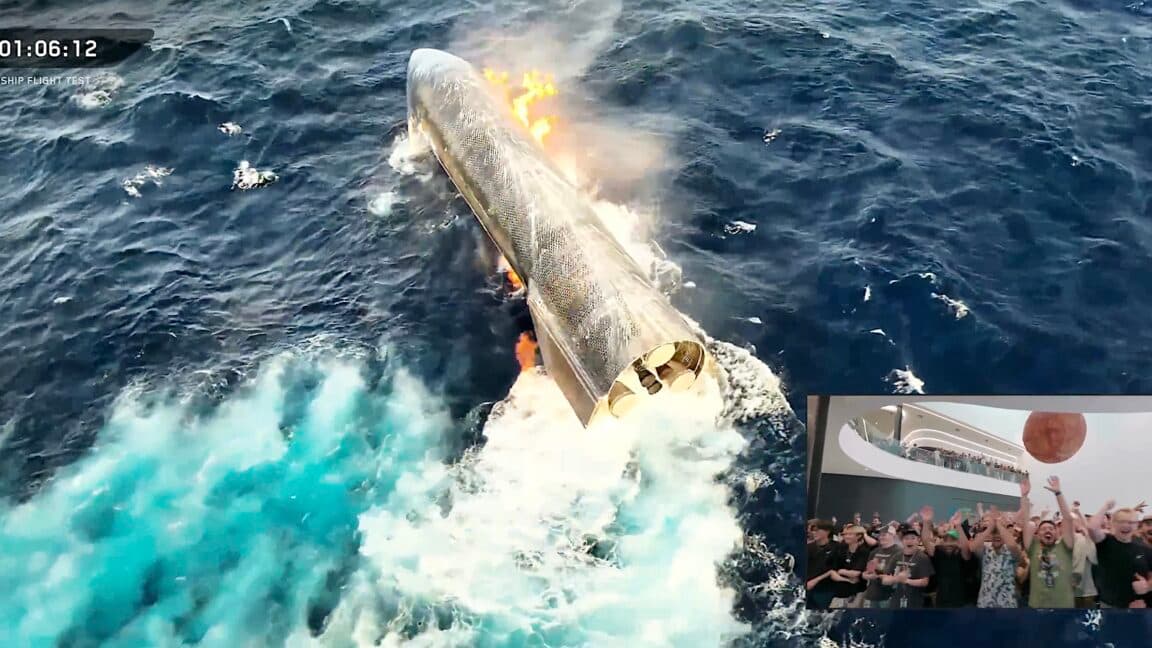
Starship Flight 13: Intact Splashdown Clears Path for Tower Catch
On July 24, 2026, SpaceX launched the 13th full-scale Starship test flight from Starbase, Texas. For the first time, the upper stage (Starship) made an intact, buoyant splashdown in the Indian Ocean, gently tipping over instead of exploding. This milestone gives engineers unprecedented heat shield data, and Elon Musk confirmed the next flight will attempt to catch Starship with the launch tower's mechanical arms.
Key Technical Details
- Vehicle: Starship Version 3, 408 feet tall, powered by 33 methane-fueled Raptor engines on the Super Heavy booster and 6 Raptors on the ship.
- Flight Profile: Suborbital trajectory, reaching space and coasting over the Caribbean, Atlantic, and South Africa before reentry. The booster failed its landing burn and crashed into the Gulf of Mexico.
- Heat Shield: Over 18,000 ceramic tiles withstood 2,600°F (1,430°C). Drone inspections post-splashdown showed minimal damage.
- Payload: Deployed 20 Starlink V3 satellites (the first of the upgraded model) via a Pez-like dispenser, which burned up on reentry after transmitting telemetry.
- Raptor Restart: A 14-second deorbit burn was successfully demonstrated, visible from South Africa.
Why This Matters for Developers
Starship's rapid iteration cycle is a model for hardware-software co-development. The vehicle runs on custom flight software, and each test provides massive telemetry data. For developers working on embedded systems, real-time control, or data pipelines, SpaceX's approach offers lessons in iterative testing and failure analysis.
Next Steps: Tower Catch and Orbital Refueling
Musk stated: "Unless we discover problems after mission data review, SpaceX will attempt to catch the ship with the tower on next flight." This maneuver has already been proven with the Super Heavy booster (though Version 3 boosters have not yet been recovered). Success would enable rapid reuse and pave the way for orbital refueling demonstrations, requiring multiple launches in quick succession.
Starlink V3: A New Revenue Stream
The Starlink V3 satellites are larger and heavier, incompatible with Falcon 9. They support higher throughput and direct-to-device connectivity for military and consumer use. SpaceX downloaded key telemetry before they burned up, validating the design.
NASA and Lunar Ambitions
NASA Administrator Jared Isaacman called Starship's capabilities "game-changing" for Artemis lunar missions. Orbital refueling is critical for sending Starship beyond low-Earth orbit, and SpaceX is building two launch pads in Florida to support high-cadence operations.
Developer Insights
- Monitor SpaceX's heat shield data releases—they often publish technical papers on thermal protection materials and reentry dynamics.
- For those building telemetry-heavy systems, study how SpaceX handles live data from thousands of sensors during high-velocity events.
- The Starlink V3 deployment mechanism (Pez dispenser) is a clever mechanical solution; consider similar approaches for satellite or payload deployment in your own designs.