PhysicsX Banks $300M at $2.4B Valuation
PhysicsX, a London-based AI startup that replaces traditional engineering simulations with AI models, has closed a $300 million Series C round. Singapore's Temasek led the round, doubling the company's valuation to $2.4 billion in less than a year. The oversubscribed round included new investors M&G Investments and Intrepid Growth Partners, with existing backers Nvidia, Applied Materials, Atomico, General Catalyst, and Siemens increasing their stakes.
What PhysicsX Builds
PhysicsX offers an AI-native engineering platform that swaps conventional physics simulations (which take hours or days) with AI models that deliver results in seconds. The company calls this approach "Large Physics Models" — an analogy to large language models, but applied to physical equations governing engines, turbines, and chips under stress. The platform combines fast AI-driven physics inference with numerical simulation to accelerate product development, reduce risk, and optimize performance.
Founded in 2019 by Jacomo Corbo and Robin Tuluie — both former Formula 1 engineers — the company emerged from stealth in 2023 with a $32 million Series A led by General Catalyst. Corbo previously co-founded QuantumBlack, McKinsey's AI division; Tuluie was head of R&D at Renault (Alpine) F1 and vehicle technology director at Bentley Motors.
Data Centres Drive Growth
Counterintuitively, the AI boom itself is fueling PhysicsX's growth. The infrastructure needed to build and operate data centres — gas turbines, compressors, cooling systems, semiconductor fabrication — creates enormous demand for accelerated engineering simulation. "Right now, candidly, we are very supply-side limited," Corbo told the Financial Times, adding that the company is moderating its rollout to existing customers due to demand. Semiconductors are expected to become PhysicsX's largest industry segment this year.
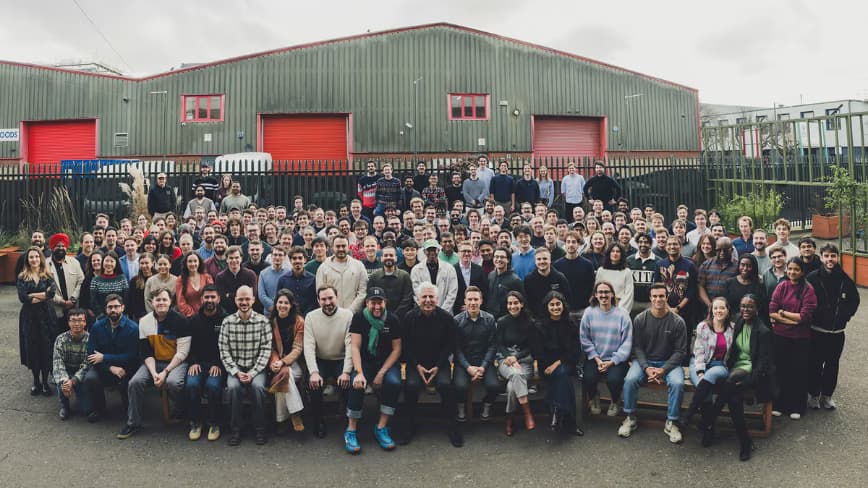
Every data centre cooling system, chip package, and power turbine that feeds the AI supply chain is a potential PhysicsX deployment. The company has grown from 150 to 350 employees over the past year and more than quadrupled revenue over the past two years.
Scaling and Staying in London
The Series C will fund US expansion and a new office in Singapore, Temasek's home market. Despite international ambitions, Corbo said PhysicsX will remain headquartered in London, describing the city as a "wonderful place" to build a global business. The $2.4 billion valuation places PhysicsX among the UK's most valuable AI startups, behind ElevenLabs and Ineffable Intelligence. It ranked second in Sifted's inaugural AI 100, a ranking of Europe's most promising AI startups.
Technical Deep Dive: How Large Physics Models Work
PhysicsX's platform replaces traditional computational fluid dynamics (CFD) and finite element analysis (FEA) with neural networks trained on simulation data. Given a geometry and boundary conditions, the AI predicts pressure, temperature, stress, and flow fields. The key technical innovation is blending learned physics with classical solvers: the AI handles the bulk of the computation, while a numerical solver runs a quick correction to guarantee physical accuracy.
This hybrid approach achieves 1000x speedups. For example, an aircraft wing design cycle that once took months now takes days. In automotive, PhysicsX claims to cut the time for crash simulation from a day to under a minute. The platform is cloud-native, exposed via a REST API, and integrates with existing CAD and PLM tools.
A typical workflow:
- Engineer uploads a CAD model (STEP or IGES) via the PhysicsX web interface or Python SDK.
- The platform meshes the geometry and runs a few high-fidelity simulations (using OpenFOAM or similar) to generate training data.
- A neural surrogate model is trained on this data, learning the physics of the specific design.
- The engineer then queries the surrogate model interactively — adjusting parameters like inlet velocity or material thickness — and gets results in real time.
- For critical evaluations, the surrogate result is validated against a full solver run.
The company's moat lies in its proprietary training algorithms that handle sparse data and extrapolation, and in its automated mesh generation that works across industries.
What This Means for Developers
For engineers working on simulation-heavy projects, PhysicsX offers a path to iterate faster without sacrificing accuracy. The platform's API-first design means it can be plugged into CI/CD pipelines for design optimization. Python developers can use the SDK to script parametric studies.
But the bigger picture: PhysicsX exemplifies a trend where AI not only powers software but also accelerates the hardware that runs AI. If you're building data centre cooling systems or chip packages, PhysicsX's tools could cut your development time from months to weeks.
Why It Matters
PhysicsX's valuation surge signals that European deep tech can command frontier-level valuations when solving measurable industrial bottlenecks. For developers, it means the tools for designing the physical world are getting a software upgrade — and fast.


