45°C Coolant Eliminates Fans, Cuts Water Use by 100%
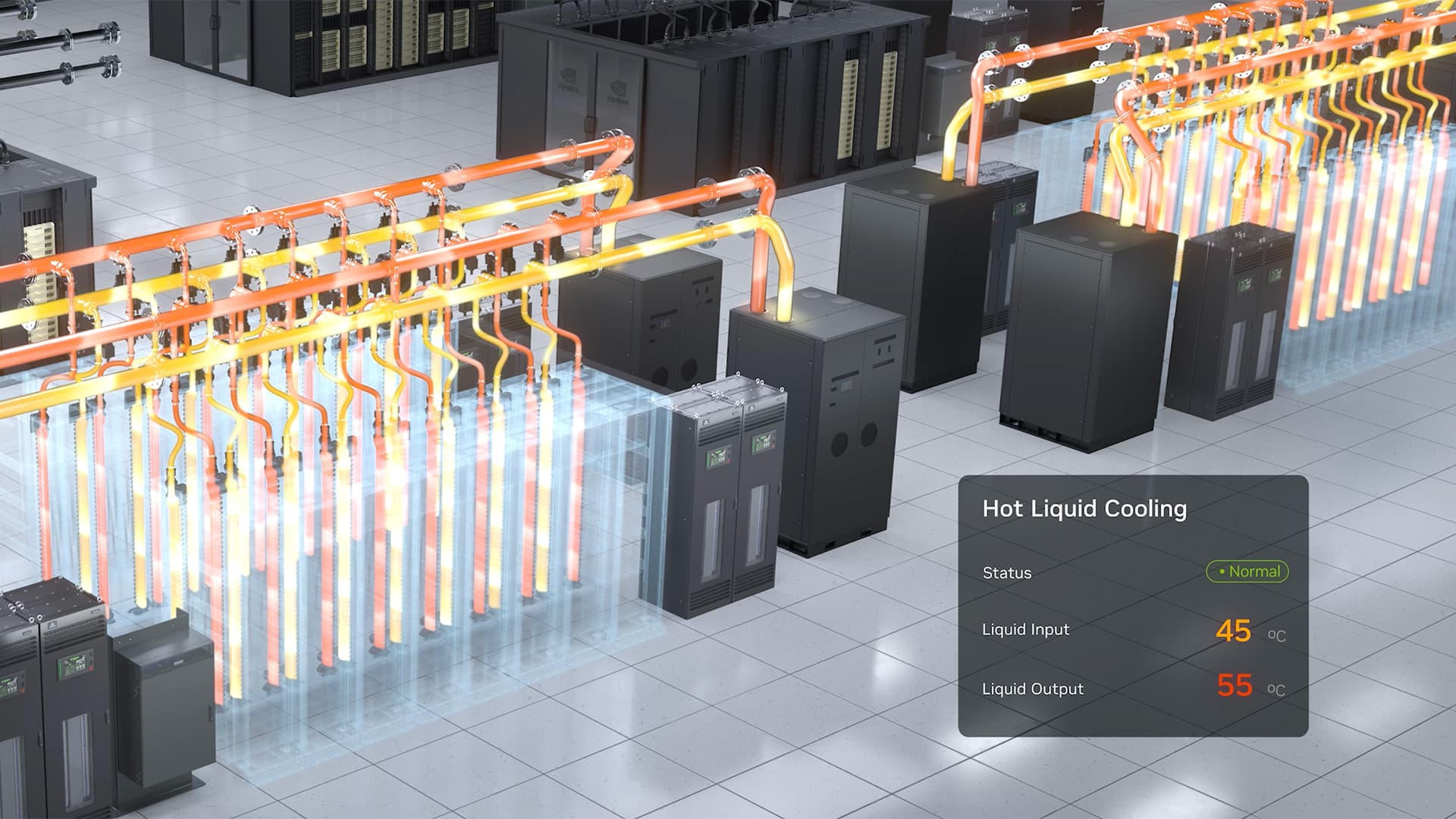
NVIDIA's Rubin generation of AI infrastructure is the first to achieve 100% liquid cooling — every chip and networking component is cooled by liquid in a closed loop, with zero fans. The coolant runs at up to 45°C (113°F), hotter than a hot tub. This high temperature is key to the efficiency gains.
According to Ali Heydari, director of data center cooling and infrastructure at NVIDIA, the DSX reference design for AI factories has "zero water consumption" with dry-cooler-based designs — a closed-loop system with no evaporative water cooling except maybe 1% of the year when chillers are needed in some climates.
The Numbers: $4M Annual Savings, 2.6M Gallons Saved
Cooling alone has historically accounted for up to 40% of a data center's electricity consumption. Industry estimates show that raising chiller plant temperatures by just one degree can cut cooling energy costs by about 4%. At a 50-megawatt hyperscale facility, moving to liquid-cooled infrastructure can save over $4 million annually in cooling-related energy and water costs.
In favorable climates, NVIDIA's 45-degree liquid-cooling architecture reduces facility cooling water consumption from roughly 2.6 million gallons per megawatt per year (for conventional cooling-tower-based systems) to near zero — up to a 100% reduction.
How It Works: Closed-Loop, No Evaporation
The coolant is 75% water and 25% propylene glycol. It flows through cold plates that sit directly on processors, pulling heat out at the source. The coolant enters the rack at 45°C and exits at roughly 55°C. Because the loop is closed, no new water is consumed. Outdoor dry coolers (large radiator coils) reject the heat to ambient air. In many climates, this eliminates the need for mechanical chillers and noisy fans.
Traditional air-cooled data centers use large volumes of cooled air, requiring energy-intensive cooling infrastructure. In Rubin-based AI factories, the ambient temperature is flexible — warm summer air is fine — because nothing in the server depends on cool air. The liquid does all the work.
Engineering Challenge: Redesigning Every Component
Previous liquid-cooled servers were hybrid: GPUs and CPUs got cold plates, but the rest of the system (memory, networking) stayed air-cooled with finned heat sinks. NVIDIA's thermal engineering team redesigned those components to use liquid cooling, designing cooling loops that simplify routing to multiple high-power chips using a single inlet and outlet per tray.
One visible outcome: Rubin servers have clean, sealed front panels (air-cooled servers have perforated bezels). Another: fully liquid-cooled servers enable higher rack density — a system that previously occupied six rack units now fits in two, delivering more compute in less space with less noise.
Industry Adoption: Ecosystem Keeping Pace
Motivair (the advanced cooling division of Schneider Electric) has worked alongside NVIDIA's product roadmap for nearly a decade. Richard Whitmore, its president and CEO, says the relationship intensified as power densities crossed the threshold where air cooling was no longer viable: "Once the watts per chip crossed a certain level, liquid cooling became mandatory."
Waste Heat Recovery: Bonus Benefit
The high-temperature coolant enables waste heat recovery — residual heat from AI factory operations can be repurposed to heat commercial or residential buildings nearby.
Developer Takeaway
If you're building or operating AI infrastructure, the shift to 100% liquid cooling with 45°C coolant is a concrete, measurable improvement. Expect to see rack densities increase, cooling costs drop, and water usage plummet. For cloud providers and data center operators, the DSX reference design is now the blueprint. If you're not already planning for liquid cooling, this is the generation to start.
For more details, see the NVIDIA DSX platform documentation.