JPEG XL: The Decade-Long Open-Source Journey to Replace JPEG
Google's JPEG XL (JXL) isn't just another codec—it's the result of a decade of open-source experimentation that pushed the limits of psychovisual modeling, entropy coding, and compression efficiency. The standard now ships in Apple's iOS, macOS, visionOS, DNG 1.7, DICOM, and upcoming PDF/EPUB revisions. Here's how they got there.
From WebP Lossless to Brotli: The Foundation (2011-2017)
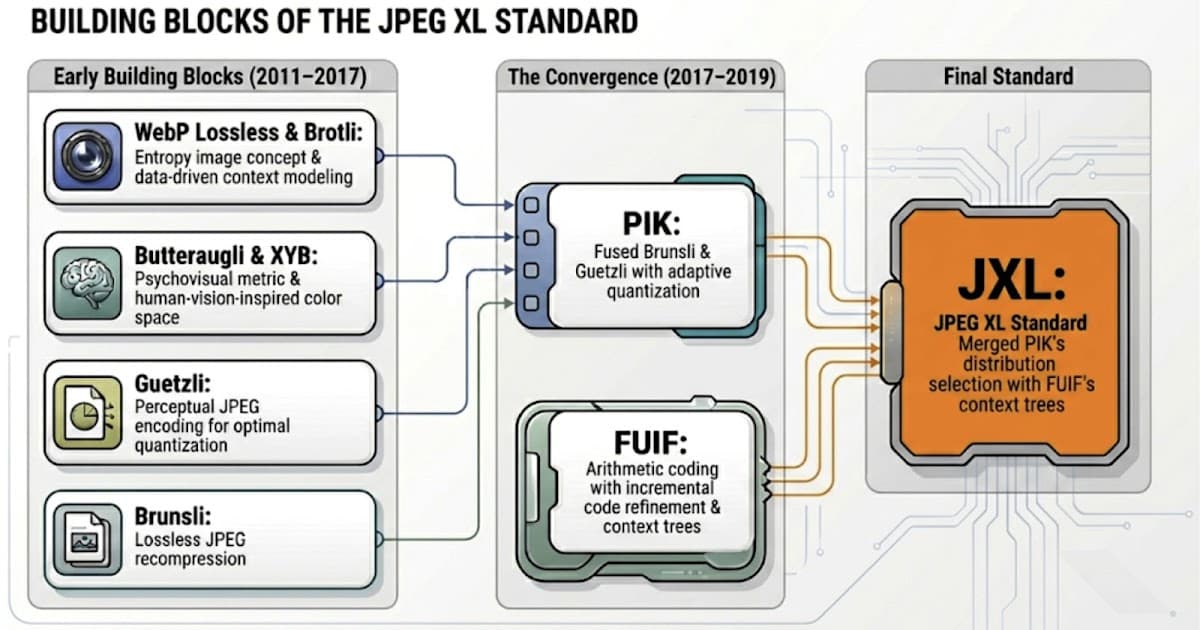
The team started by improving existing formats. WebP Lossless (2011) introduced the "entropy image" concept: a secondary image that selects static entropy codes for the primary visual data. This idea later influenced Brotli, where data-driven context modeling enabled rich context without slowing decoding.
Butteraugli and XYB: Psychovisual Modeling That Matters
By 2014, traditional metrics like PSNR and SSIM failed in color-rich environments. Google built Butteraugli and the XYB color space to mimic human edge detection and opponent-color processes at varying scales. This allowed them to compress images where artifacts were invisible to the eye.
Guetzli and Brunsli: Squeezing Legacy JPEG
Guetzli (2016) used Butteraugli to find optimal quantization tables for legacy JPEG, achieving 20-30% smaller files—but with extremely slow encoding. Brunsli (2015) offered lossless recompression of existing JPEGs without data loss. These projects revealed the limits of JPEG 1 (ISO/IEC 10918, 1992) and informed the new format's design. In 2024, Google revisited Guetzli's approach with Jpegli, making it much faster and HDR-compatible.
PIK and FUIF Merger: The Convergence (2017-2019)
In 2017, Google open-sourced PIK, combining Brunsli's efficiency with Guetzli's psychovisual optimizations, plus an adaptive quantization field. PIK was submitted to ISO. The committee demanded extreme density—bit rates as low as 0.06 BPP (35x compression vs. internet-quality images, 80x vs. camera output). This forced the Variable-block-size Discrete Cosine Transform (VarDCT) architecture, central to JPEG XL.
Cloudinary's FUIF proposal used incremental refinement during decoding. The final JPEG XL merged PIK's faster-to-decode distribution selection with FUIF's context trees—a best-of-both-worlds compromise.
JPEG XL Today: Ecosystem Adoption
The codec's ability to handle high bit-depth, lossless data, and HDR efficiently has driven adoption:
- Photography: DNG 1.7, Apple ProRAW
- Medical: DICOM standard
- Publishing: Future PDF and EPUB versions
Native support exists in Adobe software, Apple's OSes, Ubuntu, and Microsoft's JPEG XL Image Extension for Windows. libjxl-tiny inspired Shikino High-Tech and CAST to release the first commercial JPEG XL encoder IP core for ASIC/FPGA, targeting real-time, low-power capture. Safari has supported JXL since 2023; Firefox and Chrome keep experimental support.
Technical Details: VarDCT and Entropy Coding
The VarDCT block size ranges from 2x2 to 256x256, allowing fine-grained quality allocation. Entropy coding uses a hybrid of PIK's precomputed distribution selection and FUIF's context trees. For developers, encoding with cjxl:
cjxl input.png output.jxl --distance 1.0 --effort 7
Decoding is handled by djxl. The --distance parameter controls psychovisual quality (lower is better).
The Open-Source Philosophy
Google's approach was to release minimum-viable prototypes (Guetzli, Brunsli) to gather community feedback. The team ran "thousands, if not tens of thousands" of experiments in psychovisual modeling, entropy, and coding speed. This iterative, open process shaped a standard designed to last 30 years.
Why It Matters Now
JPEG XL isn't just a better compression—it's a foundation for HDR, wide color gamut, and lossless workflows. If you handle images in medical, photography, or publishing, JXL is becoming mandatory. For web developers, browser support is the main gap—but with Apple and Microsoft onboard, it's only a matter of time.

