The ruling
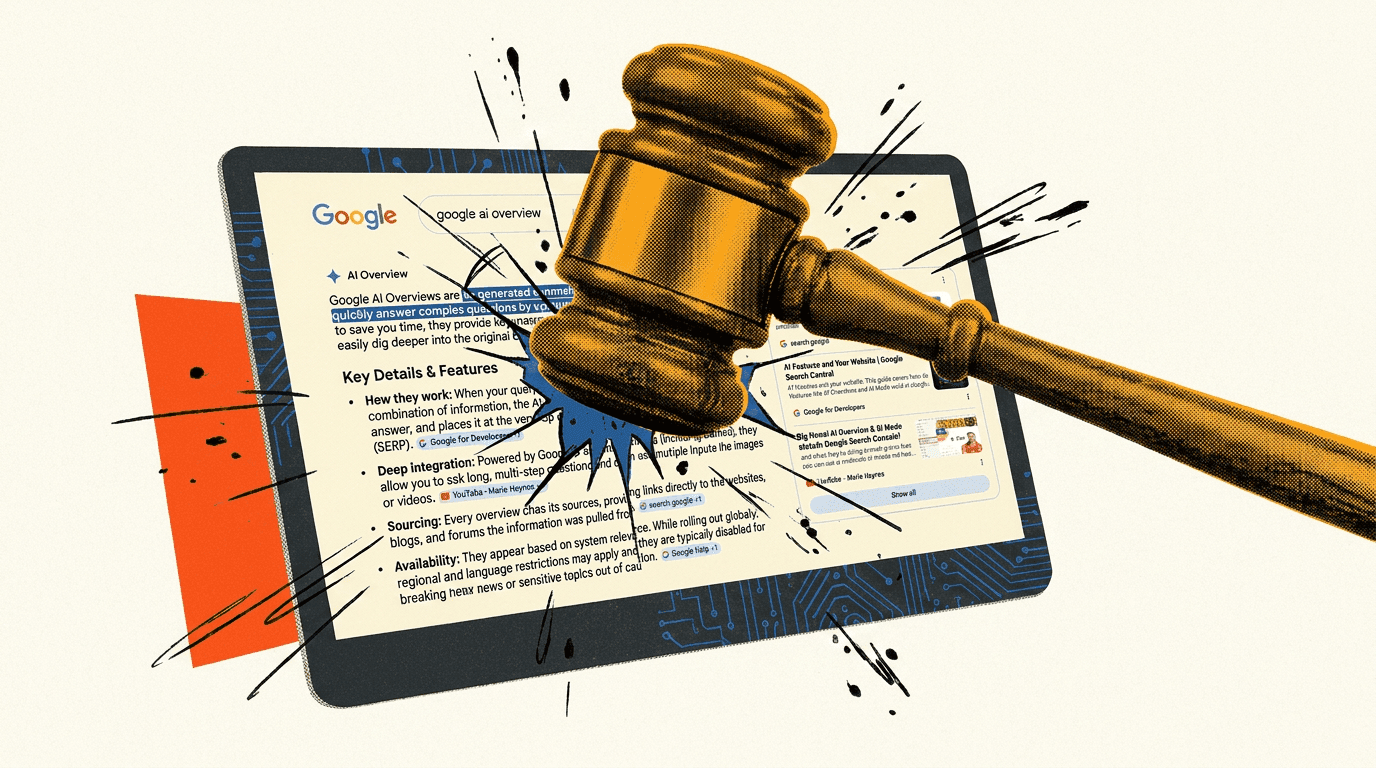
On [date unclear], the Regional Court of Munich (case no. 26 O 869/26) granted a temporary injunction against Google. The court found that Google's AI Overviews are not search results but Google's own content. Therefore, Google is directly liable for false claims made in those overviews.
What happened
Two Munich-based publishers discovered that for certain search queries, Google's AI Overview falsely linked them to scams, subscription traps, and shady business practices. The AI had mixed up information about other companies with the plaintiffs and invented connections that didn't appear in any linked source. The publishers sent a cease-and-desist letter; Google didn't respond appropriately.
Why AI Overviews aren't search results
The court argued that AI Overviews work fundamentally differently from traditional search results. The AI "rewrites and judges results in its own words and according to its own structure." In this case, the overview opened with "Yes, [company] is known for dubious business practices," then built its own structure with summaries and red flags. Crucially, the AI made claims "that are not even made in the search results." None of the linked sources connected the plaintiffs to the shady companies the AI mentioned. The court called these "the defendant's own statements."
Google built the AI, Google offered it to users, so Google owns what it produces, "because it alone has influence over the AI's offering and the algorithms with which the AI operates."
Search engine liability rules don't apply
Previous German Federal Court of Justice (BGH) rulings gave traditional search engines and autocomplete limited liability. The BGH reasoned that search engines merely make third-party content findable, so they are only indirect infringers. A proactive duty to check results would threaten how search engines work.
The Munich court found this reasoning doesn't apply to AI Overviews. A regular search engine points to outside websites. But AI Overviews generate "independent, new, and substantive statements" by evaluating and combining content from various third-party sites. Only Google can check those statements, "at least by comparing the underlying third-party websites with its own statements based on them."
The court also noted that AI Overviews are "by no means absolutely necessary" for using the internet. Traditional search results already help users sort through information; the AI Overview is just an extra feature.
Google's defense fails
At the hearing, Google argued that users can check linked sources to verify the AI summary. Users generally know "that information generated with AI should not be blindly trusted." The court rejected this. The possibility of disproving a statement through further research doesn't "regularly exempt from liability for this statement." The AI Overview was "understandable on its own" and contained "a self-contained statement with independently understandable content and no reference to other possible interpretations or even unreliable content." Studies show that users almost never click on sources in AI Overviews.
The court drew a parallel to press law: publishers are liable for teasers that are understandable on their own, even if readers never read the full article. Google's own argument would "significantly diminish" the benefit of the feature if the overview were "generally recognized as unreliable."
The court also pointed to a protection gap. If Google were only liable for obvious violations, victims would have no real legal recourse when the AI makes false claims. The third parties whose websites served as sources hadn't even made the statements in question. So victims couldn't sue the sources, and under existing rules they couldn't effectively sue Google either.
As a result, Google couldn't invoke host provider protections under the Digital Services Act or fall back on the standard notice-and-take-down process for search engines.
AI-generated opinions get less free speech protection
An AI's opinion is "not the expression of an acquired conviction of the persons expressing it, but the result of an algorithm," the court wrote. Offering AI-powered research is "above all an expression of Google's business activities" and "at most a secondary expression of an interest in being able to freely express one's opinion and beliefs."
When weighing the plaintiffs' privacy rights against Google's interests, Google had to take a back seat, especially since the challenged statements were based on untrue facts. The AI had linked the plaintiffs to companies that, according to sworn affidavits, had no connection to them whatsoever.
Costs and reach
The court banned claims about scams, connections to dubious companies, subscription traps, phone calls that never happened, and lack of availability. Only two minor requests were denied. Google covers 80 percent of the legal costs; the plaintiffs pay 10 percent each. The ruling may also have international reach.
Scale of the problem
An analysis by AI startup Oumi for the New York Times found that Google's AI Overviews with the current Gemini 3 model answered correctly 91 percent of the time. That's solid for everyday use, but at Google's scale, it still means millions of wrong answers every hour. The Oumi analysis also found that 56 percent of the correct Gemini 3 answers couldn't be backed up by the sources Google linked. The AI gives answers whose origins users can't trace.
What this means for developers
If you build AI features that paraphrase web content, this ruling is a warning. The court's reasoning could apply to any AI that generates "independent, new, and substantive statements" from third-party data. If your AI invents false claims, you may be directly liable. You cannot hide behind safe harbor provisions designed for search engines. Consider implementing fact-checking mechanisms, source validation, and clear disclaimers. And if you receive a cease-and-desist, respond promptly.