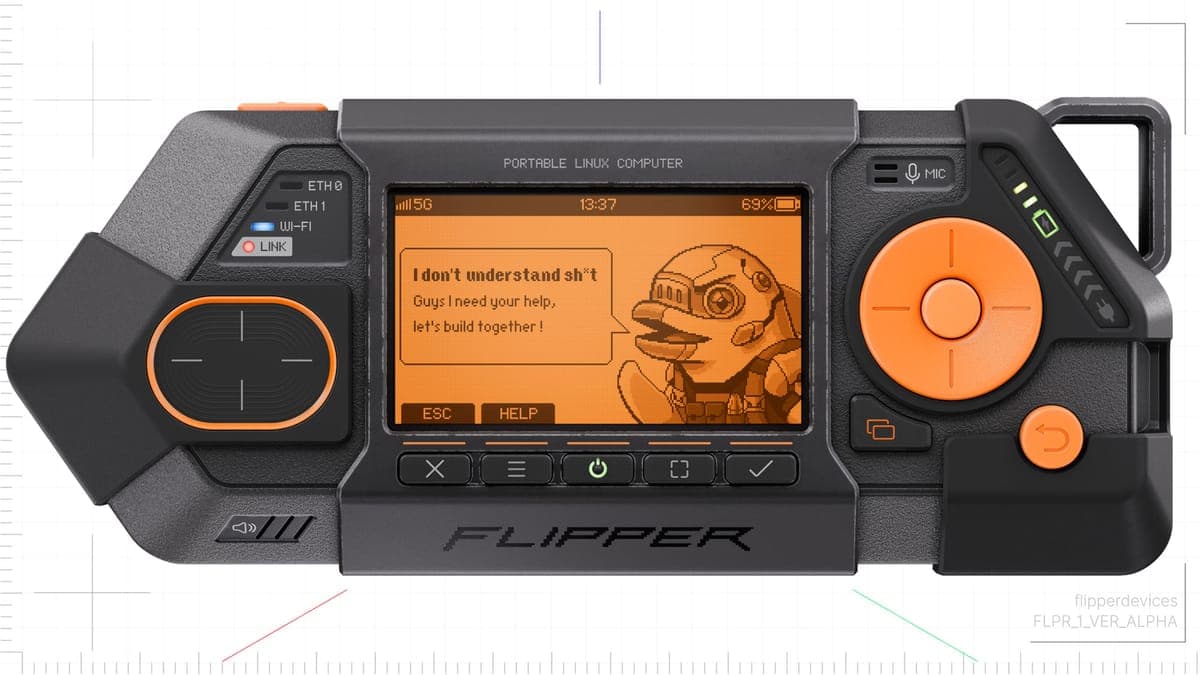
Flipper One: An Open Linux Cyberdeck with Co-Processor Architecture
Flipper One is not an upgrade to Flipper Zero. It's a completely different project: an open Linux platform designed for networking, SDR, and local AI. The team has partnered with Collabora to push full mainline Linux kernel support for the Rockchip RK3576 SoC. They're opening up their development process and asking the community for help.
What is Flipper One?
Flipper One is a Linux cyberdeck built on a co-processor architecture. It pairs an 8-core RK3576 CPU (with Mali-G52 GPU and NPU) with a Raspberry Pi RP2350 microcontroller. The MCU controls the display, buttons, touchpad, and power subsystem, and can run independently when Linux is off. The two processors communicate over SPI (framebuffer), I²C (commands), and UART (boot control).
The device features 2x Gigabit Ethernet, USB Ethernet (5 Gbps), Wi-Fi 6E, and expansion via PCI Express, USB 3.0, and SATA. You can add an SDR, fast SSD, or cellular modem. It comes with 8 GB of RAM.
Truly Open Linux
The team's goal is full mainline kernel support with zero binary blobs. They're working with Collabora to upstream the RK3576 SoC. Currently, most major components work upstream, but the DDR trainer (initializes RAM during early boot) remains a binary blob. The team is asking the community to help convince Rockchip to open it up or find a workaround.
Flipper OS and FlipCTL
Flipper OS is a layer on top of Debian that introduces profiles—full snapshots of the OS with different packages and settings. You can boot a profile, clone it, break it, and jump back to a clean copy. The concept is still in prototyping; the team is not 100% sure how to architect it yet.
FlipCTL is a UI framework for small screens, solving the problem of squeezing desktop environments onto tiny displays. It's designed for cyberdeck builds and will be open source.
Developer Portal
The Flipper One Developer Portal is a public wiki where anyone can contribute. It covers hardware, mechanics, Linux software, MCU firmware, UI, docs, and testing. The team is hiring a Developer Portal & Community Manager to bridge between developers and the community.
Current Status and How to Help
The RK3576 mainline support is in good shape, but power management and USB DP Alt-mode support need work. The NPU, hardware video decoding, and other accelerators are not yet upstream. Collabora maintains a public list of what's working and what isn't. Contributions of any kind are welcome—code, documentation, or even convincing Rockchip to open up the last blob.
Technical Details
- SoC: Rockchip RK3576 (8 cores, ARM)
- GPU: Mali-G52
- NPU: For local LLM inference
- MCU: Raspberry Pi RP2350 (dual-core Cortex-M33)
- RAM: 8 GB
- Storage: microSD, optional M.2 SSD via PCIe
- Networking: 2x Gigabit Ethernet, USB 5 Gbps Ethernet, Wi-Fi 6E
- Expansion: PCIe, USB 3.0, SATA
- Boot: MCU controls CPU boot; Flipper OS uses profiles
Why It Matters
Flipper One aims to fix the broken state of ARM Linux, where vendors ship closed BSPs and binary blobs. If successful, it will be the best-documented ARM computer with full upstream kernel support, setting a new standard for openness. Developers can use it as a portable Linux box, router, SDR platform, or AI edge device—all with a clean, rollback-friendly OS.
Editor's Take
I've been following the Flipper Zero community for years, and this pivot to a full Linux platform is bold. I'm skeptical about the co-processor architecture adding complexity, but the ability to run the MCU independently is a killer feature for embedded work. I hope they succeed in upstreaming everything—the RK3576 is a great chip, and a truly open SBC would be a game-changer for cyberdeck builders. I'll be watching the developer portal closely.

