The C64 Dead Test Cartridge Font: MICR Easter Egg and Ultimax Mode
The Commodore 64 Dead Test diagnostic cartridge (Rev. 718220, part № 314139-03) has a distinctive font that, until now, was undocumented. The font is embedded in the cartridge's ROM, allowing it to function even when the C64's built-in ROMs are dead. This article documents the character set, reveals a hidden Easter egg, and explains the Ultimax memory map that makes it work.
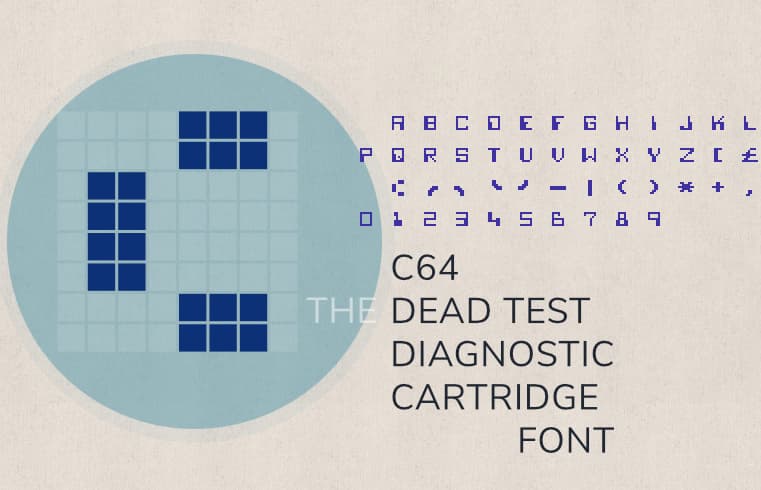
The Font: 58 Characters Inspired by MICR E-13B
The Dead Test cartridge implements only 58 characters (screen codes $00–$39), covering uppercase letters, digits, and a few punctuation marks. The box border characters (╭╮╰╯─│) replace the normal " # $ % & ' at codes $22–$27. A blank occupies code $00 (normally @). The fill pattern for undefined codes is $AA (vertical stripes).
Visually, the font is clearly inspired by the MICR (Magnetic Ink Character Recognition) set E-13B, which contains only 14 glyphs (digits 0-9 and 4 symbols). The Dead Test digits closely match MICR, except the '3' is more boxy. The uppercase letters follow the same style, fitting a 6×7 pixel box, with M and W spreading to 7×7.
The Easter Egg: MICR Transit Symbol at Screen Code $21
Screen code $21 (normally the exclamation mark) contains a mysterious C-shaped character. This character is never referenced anywhere in the cartridge code — it's a hidden Easter egg. It is the MICR "transit" symbol, used as a delimiter for bank routing codes. This is a direct nod to the MICR inspiration.
Implementation: Ultimax Mode and Memory Map
The C64 can operate in Ultimax mode (also called Max Machine mode) when the cartridge signals _GAME low and _XROM high. This mode disables all built-in ROMs and provides only 4K of RAM ($0000–$0FFF) and two 8K cartridge ROM banks: ROML at $8000–$9FFF and ROMH at $E000–$FFFF. The system vectors (including the RESET vector) are in ROMH, so the cartridge must provide them.
The Dead Test cartridge is an 8K Ultimax cartridge with its ROM at $E000–$FFFF and reset vector at $E000. The font data starts at $EAD8, with the remaining space filled with $AA. Each character is an 8×8 matrix (8 bytes), stored row by row. For example, the 'A' character (screen code $01) is:
EAE0: 7E    ;  .******.
EAE1: 42    ;  .*....*.
EAE2: 42    ;  .*....*.
EAE3: 7E    ;  .******.
EAE4: 46    ;  .*...**.
EAE5: 46    ;  .*...**.
EAE6: 46    ;  .*...**.
EAE7: 00    ;  ........
This is the same technique used by early C64 game cartridges like Omega Race, which are also Ultimax cartridges.
Character ROM Downloads
The blog post includes downloadable Commodore 8-bit character ROMs (the Dead Test font and the standard C64 character set) for emulator use or analysis.
Why This Matters for Developers
Retrocomputing enthusiasts and anyone interested in low-level hardware diagnostics will appreciate this documentation. The hidden Easter egg shows how developers can embed secret references in fonts. The Ultimax mode technique is a clever way to test hardware independently of the system ROMs.
Next Steps
If you're working on a C64 emulator or diagnostic tool, you can now accurately reproduce the Dead Test font. Download the character ROMs from the source article and integrate them into your project.


