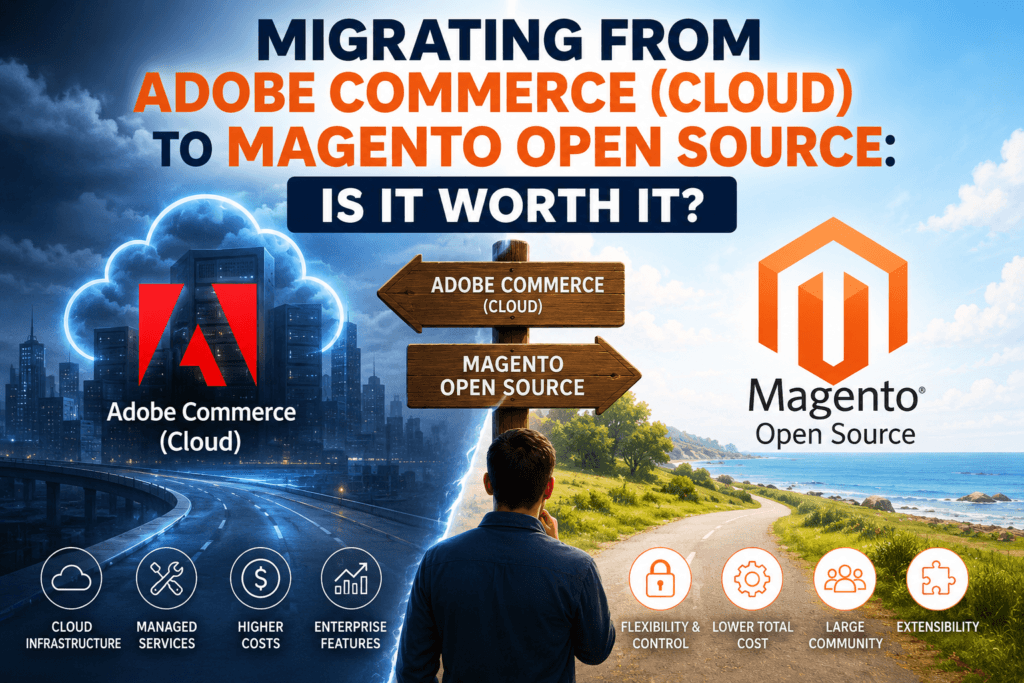
Adobe Commerce Cloud now costs $40k/year. We migrated to Magento Open Source — here's the honest breakdown
For mid-size eCommerce businesses, Adobe Commerce Cloud (formerly Magento Enterprise) has become a $22,000–$40,000+ annual license burden. Many merchants discover they pay for features they never use: B2B Suite, Adobe Sensei AI, Gift Cards, Visual Merchandiser. The core Magento framework is identical between Commerce Cloud and Open Source — the difference is proprietary modules and a locked-down hosting environment.
The Cost Math Nobody Publishes
| Category | Adobe Commerce (Cloud) | Magento Open Source |
|---|---|---|
| License | $22k–$40k+/year | Free |
| Hosting | Included (limited control) | Any (e.g., Hypernode) |
| Support | Adobe shared queue | Dev partner or in-house |
| Flexibility | Tied to Adobe ecosystem | Full code control |
| Release cycles | Adobe-driven | On your terms |
For a store doing ~$3M annual GMV, switching to Open Source reduces platform costs by 40–60%. Over 5 years, that's $100k–$250k saved — money better spent on customer acquisition, UX improvements, or marketing automation.
What Actually Changes for Developers
Both platforms share the same Magento core. Your custom modules, themes, and most third-party extensions work unchanged. The shift is in removing Adobe-only modules and gaining infrastructure freedom.
Database Schema Gotchas
Magento Open Source uses the same database schema as Commerce Cloud, but EE-specific tables must be handled:
row_idvsentity_idusage in staging and versioning tables- B2B feature tables (
negotiable_quote,company,shared_catalog) - Adobe Sensei AI prediction tables
During migration, you must map these tables or drop them. A proper migration includes full backup, staging environment, and rollback plan.
B2B Suite Trap
Adobe Commerce includes B2B Suite (company accounts, negotiable quotes, shared catalogs). On Open Source, these features are absent. Replacements exist from third-party vendors:
- Company accounts: Use a custom module or extension like Mageplaza B2B
- Negotiable quotes: Implement with a custom quote system
- Shared catalogs: Configure via category permissions
Expect 2–4 months for a typical mid-size store migration, including audit, data migration, module replacement, testing, and go-live.
Performance and Infrastructure Freedom
After migration, you can choose any hosting stack. Hypernode, for example, offers optimized Magento hosting with Varnish, Redis, and CDN built-in. Developers gain:
- Full control over deployment (CI/CD, Git workflows, dev/stage/prod)
- No forced Adobe release cycles — apply security patches on your schedule
- Ability to tune Core Web Vitals without Adobe restrictions
When to Migrate
Consider migration if:
- Your Adobe license is $20k–$40k+/year but you only use core features
- You want more control over UX, infrastructure, or release cycles
- Adobe Cloud performance is limiting growth
- You want to reduce long-term platform risk and cost
The Migration Process
- Business Review: Audit which Adobe features you actually use. Most merchants discover they pay for features they never enable.
- Technical Audit: Review custom modules, extensions, theme, and hosting. Identify dependencies on Adobe-only modules.
- Cost & Benefit Analysis: Compare total cost of ownership over 5 years. Include license fees, development costs, and scaling needs.
- Risk & Dependency Check: Identify modules that require custom replacements.
- Planning: Create a roadmap with timeline, stages, fallback options, and test steps.
Final Thoughts
Migrating from Adobe Commerce Cloud to Magento Open Source is a strategic investment in flexibility and autonomy. The financial savings are significant — $100k–$250k over 5 years — but the greater value is the ability to adapt, scale, and differentiate faster than competitors. If your Adobe setup limits growth, slows development, or consumes too much budget, Open Source gives you control without sacrificing Magento's power.
Next step: Run a technical audit of your current Adobe Commerce setup. Identify which proprietary modules you use. Compare 5-year TCO with Open Source. Then decide.

